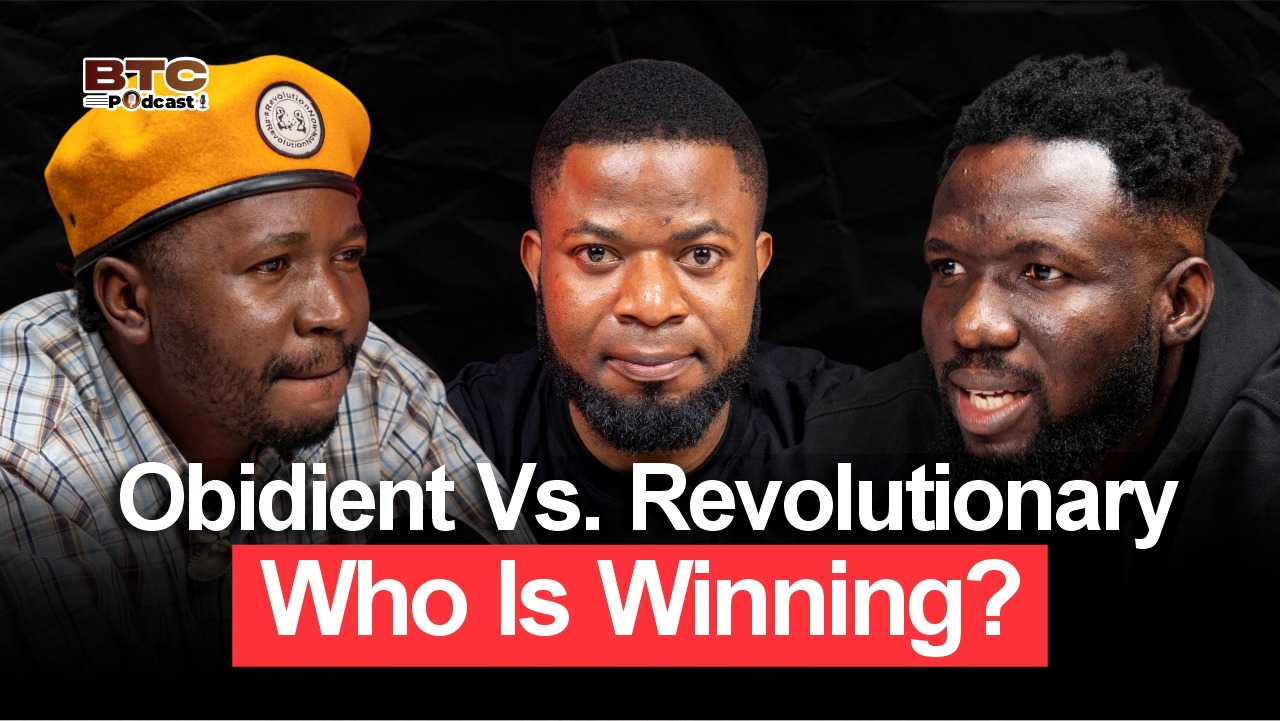
Peter Obi vs Sowore: The Heated 2027 Debate Nigerians Need to Watch
Can Peter Obi or Omoyele Sowore offer Nigerians the leadership they are looking for in 2027?
That question took centre stage on the latest episode of the Before Tomorrow Comes Podcast (BTC Podcast), hosted by Prince Gabriel Okocha (PGO), in one of the most intense political conversations yet on the platform.
The episode brought together two passionate voices with very different political convictions: Mr. Signature, a strong supporter of Peter Obi, and Manasseh, popularly known on social media as Revolutionary Chief Priest, who made the case for Omoyele Sowore.
What followed was far more than a conventional political interview.
It was a passionate debate about leadership, political strategy, corruption, the Nigerian economy, unemployment, education, fuel subsidy, governance, political experience and, ultimately, the question many Nigerians are already asking:
Who should Nigerians trust with the future of the country in 2027?
Peter Obi vs Sowore: What Was the BTC Podcast Debate About?
From the opening stages of the conversation, it became clear that this would not be a predictable political discussion.
Mr. Signature argued that Peter Obi represents a more viable path toward changing Nigeria from within the political system, pointing to what he described as Obi’s experience, record and growing political structure.
Manasseh, on the other hand, argued that Sowore represents a fundamentally different approach — one rooted in activism, challenging the political establishment and refusing to become part of the system he believes has failed Nigerians.
The disagreement quickly moved beyond personalities.
At its core, the debate became a clash between political experience and political disruption.
One side argued that Nigeria needs someone capable of working within institutions and governing effectively.
The other argued that Nigeria needs someone willing to fundamentally challenge the institutions and political culture responsible for the country’s problems.
That contrast kept the conversation heated for almost two hours.
Manasseh aka Revolutionary Chief Priest Makes the Case for Sowore
Manasseh’s argument for Omoyele Sowore centred heavily on activism, accountability and the need to challenge entrenched political structures.
He pointed to Sowore’s history as an activist and his long-running criticism of successive Nigerian governments. He argued that Sowore’s willingness to confront those in power is precisely what distinguishes him from conventional politicians.
For Manasseh, the argument is not simply about whether Sowore has previously occupied a major government position.
It is about whether Nigerians are willing to choose someone outside the traditional political establishment.
He also argued that Nigeria’s problems cannot be solved without addressing fundamental issues such as electricity, internet connectivity, infrastructure, access to jobs, opportunities for young Nigerians and corruption.
His argument was essentially that a functioning economy creates opportunities — and that government should create the conditions in which Nigerians can succeed without needing political connections.
The discussion became particularly personal when Manasseh used examples from his own experience with online work and forex trading to explain how unreliable electricity and connectivity can affect young Nigerians trying to earn a living.
Mr. Signature Defends Peter Obi’s 2027 Ambition
Mr. Signature approached the debate from a different angle.
His central argument was that Nigeria does not simply need someone who can criticize the system. It needs someone who understands how to govern, build institutions and manage a complex economy.
He repeatedly defended Peter Obi’s experience, arguing that Obi’s background in business and government gives him an advantage over a candidate whose strongest credentials are rooted in activism.
He also argued that Peter Obi’s supporters have built a stronger political structure since the 2023 presidential election and suggested that the former Anambra governor’s political momentum should not be judged simply by previous election figures.
For Mr. Signature, the 2027 contest is about moving beyond protest and opposition into actual governance.
His argument was summed up by a recurring theme throughout the conversation: Nigeria needs a leader who can build systems that work rather than simply react to problems after they occur.
Can Peter Obi Really Win the 2027 Presidential Election?
One of the most important questions raised during the episode was whether Peter Obi’s political momentum has increased or declined since the 2023 election.
The discussion touched on the growth of political structures, alliances, regional support and the broader opposition movement.
Mr. Signature argued that Obi’s political relevance remains significant and that developments since 2023 should not be ignored.
Manasseh challenged the argument from another direction, questioning whether popularity, online support and previous electoral performance are enough to guarantee victory in 2027.
This created one of the episode’s biggest underlying questions:
Is 2027 going to be about the candidate with the strongest existing political structure, or the candidate capable of creating the biggest political disruption?
There was no easy answer.
And that is precisely what makes the conversation worth watching.
Sowore vs Peter Obi: Leadership, Experience and Track Record
The debate repeatedly returned to the issue of leadership experience.
Mr. Signature argued that becoming president requires more than passion, activism or the ability to mobilize people against government.
In his view, the Nigerian presidency requires an understanding of institutions, economics, administration and governance.
Manasseh pushed back against the idea that previous government experience should automatically be treated as an advantage.
His position was that Nigeria’s political establishment has had decades to deliver better governance, yet many Nigerians continue to struggle with unemployment, poor infrastructure, unreliable electricity and limited economic opportunities.
The disagreement therefore became philosophical:
Does Nigeria need an experienced political operator, or does it need an outsider willing to disrupt the existing political order?
That question runs through almost the entire episode.
The Economy, Fuel Subsidy and the Cost of Governance
The conversation also moved deeply into Nigeria’s economic challenges.
One of the most detailed exchanges centred on fuel subsidy and how a future administration should approach it.
Mr. Signature argued that the problem is not necessarily the concept of government intervention itself, but the way such policies are implemented and managed.
He argued that a Peter Obi administration would focus on transparency, reducing waste and redirecting resources toward productive sectors such as healthcare, education and enterprise development.
The conversation also touched on the broader question of whether Nigeria should be moving from a consumption-driven economy toward one based more heavily on production.
That led to a wider discussion about taxation, public spending, enterprise and the role of government in creating an environment where businesses and individuals can become productive.
It was one of the sections where the political debate became an economic policy debate.
Unemployment: What Can Actually Create Jobs?
Another major subject was unemployment.
Manasseh argued that Nigerians should not have to rely on connections or payments to access employment opportunities.
He highlighted electricity, internet connectivity, roads, water and digital infrastructure as examples of areas where better public services could create opportunities for businesses and young Nigerians.
He also pointed toward sectors such as agriculture and technology as areas with significant potential for job creation.
The discussion became particularly interesting when the speakers began connecting infrastructure to the modern Nigerian digital economy.
For young Nigerians working remotely, trading online, creating content or running internet-based businesses, electricity and reliable connectivity are not luxuries.
They can directly affect income.
The debate therefore raised an important question:
What should government actually do to create an economy where young Nigerians can build sustainable livelihoods?
Corruption, Accountability and the Question of Political Power
Few subjects generated as much disagreement as corruption and accountability.
Manasseh’s argument was that Sowore’s history of confronting government and demanding accountability is part of what makes him a credible alternative.
Mr. Signature countered that fighting corruption requires more than identifying corrupt individuals. He argued that Nigeria needs stronger institutions capable of preventing corruption and holding people accountable through functioning systems.
This produced one of the clearest philosophical differences between the two sides.
Manasseh emphasized confrontation and accountability.
Mr. Signature emphasized institution-building and prevention.
Both claimed to want a Nigeria where corruption is reduced.
Their disagreement was over how to get there.
One of the Most Heated Moments: Can Sowore Build the Government He Promises?
As the debate progressed, the temperature rose.
The conversation moved into questions about how Sowore would govern, how his proposed policies could be implemented and whether his approach could translate from activism into the management of an entire country.
Mr. Signature questioned whether some of the positions associated with Sowore’s campaign could realistically be implemented at the scale of the Nigerian federal government.
Manasseh defended the underlying ideas and argued that Nigerians should not automatically dismiss unconventional proposals simply because they challenge existing political thinking.
The exchange demonstrated one of the biggest differences between the two camps:
One side wants Nigerians to focus on what is politically achievable.
The other wants Nigerians to consider what might become possible if the political system itself changes.
The Debate Gets Personal
The BTC Podcast episode was not a polite exchange of prepared talking points.
There were interruptions, challenges, accusations, jokes and moments when PGO had to step in and bring the conversation back under control.
That tension, however, also made the episode feel authentic.
Rather than listening to two politicians delivering rehearsed campaign speeches, viewers were watching two people passionately defend political ideas they genuinely believe in.
And throughout it all, PGO’s role as host was particularly important: keeping the discussion moving, challenging both sides and making sure neither guest completely dominated the conversation.
The result was a conversation that remained energetic from beginning to end.
A Debate About More Than Peter Obi and Sowore
Perhaps the biggest takeaway from the episode is that the conversation is bigger than two presidential candidates.
It is really a conversation about the kind of Nigeria people want to build.
Should Nigeria prioritize experienced political leadership?
Should Nigerians take a chance on an outsider?
Should political movements focus on building coalitions and structures?
Or should they continue challenging the political establishment from outside?
Should the country focus first on economic growth, jobs and infrastructure?
Or should institutional reform and accountability come first?
These are not questions that can be answered by one political slogan.
They require Nigerians to examine the candidates, their ideas, their records, their supporters and — most importantly — what they believe the country needs.
PGO’s Final Message: The Choice Belongs to Nigerians
As host of the Before Tomorrow Comes Podcast, Prince Gabriel Okocha brought the debate to a close by reminding viewers that the final decision belongs to Nigerians.
After nearly two hours of intense disagreement, both guests were given an opportunity to make their final appeal.
Mr. Signature used his closing statement to make a case for Peter Obi and argued that Sowore’s activism should be combined with a broader opposition movement capable of winning power.
Manasseh used his closing statement to make the case for Sowore, emphasizing his integrity, activism, opposition to corruption and willingness to challenge the political establishment.
Then PGO delivered the final word.
The choice, he reminded Nigerians, is theirs.
One vote. One decision. One future.
Why You Should Watch the Full BTC Podcast Episode
Political debates are often reduced to short clips on social media.
A 30-second video can make someone look convincing.
Another 30-second clip can make the same person look completely wrong.
But the Before Tomorrow Comes Podcast episode gives viewers something social media clips cannot: the opportunity to hear both sides develop their arguments over an extended conversation.
You get to hear the claims.
You get to hear the counterarguments.
You get to watch the disagreements unfold.
And you get to make up your own mind.
Whether you support Peter Obi, Omoyele Sowore, another candidate entirely, or you are still undecided about Nigeria’s political future, this is a conversation worth watching.
Watch Manasseh and Mr. Signature Debate Peter Obi vs Sowore on BTC Podcast
The latest episode of Before Tomorrow Comes Podcast (BTC Podcast), hosted by Prince Gabriel Okocha (PGO), brings together two passionate voices for one of the most engaging conversations yet about Nigeria’s political future.
Manasseh, popularly known as Revolutionary Chief Priest, argues for Omoyele Sowore.
Mr. Signature argues for Peter Obi.
Their disagreement covers the economy, corruption, unemployment, leadership, political strategy, fuel subsidy, education, infrastructure, governance and the 2027 presidential election.
And by the end, there is one question left for every Nigerian:
Who do you believe can build the Nigeria you want to see?
Watch the full episode, listen to both sides and decide for yourself.
Before Tomorrow Comes Podcast — because the decisions we make today shape the Nigeria we wake up to tomorrow.
Key Topics Covered
- Peter Obi vs Sowore
- Peter Obi’s 2027 presidential ambition
- Omoyele Sowore and the 2027 election
- Manasseh aka Revolutionary Chief Priest
- Peter Obi’s political experience and leadership
- Sowore’s activism and political movement
- Nigeria’s economy
- Fuel subsidy
- Corruption and accountability
- Unemployment and job creation
- Education and healthcare
- Electricity and digital infrastructure
- Political alliances and opposition strategy
- The future of Nigeria
- The 2027 Nigerian presidential election
- The role of young Nigerians in Nigeria’s political future
- Can an outsider defeat Nigeria’s established political system?
About Before Tomorrow Comes Podcast
Before Tomorrow Comes Podcast (BTC Podcast) is hosted by Prince Gabriel Okocha (PGO) and provides a platform for conversations about Nigeria’s future, politics, leadership, society, business and the issues that matter before tomorrow comes.
The podcast brings different perspectives to the table and gives guests the opportunity to explain, challenge and defend their positions.
Because the future is not something we simply wait for.
We shape it with the decisions we make today.