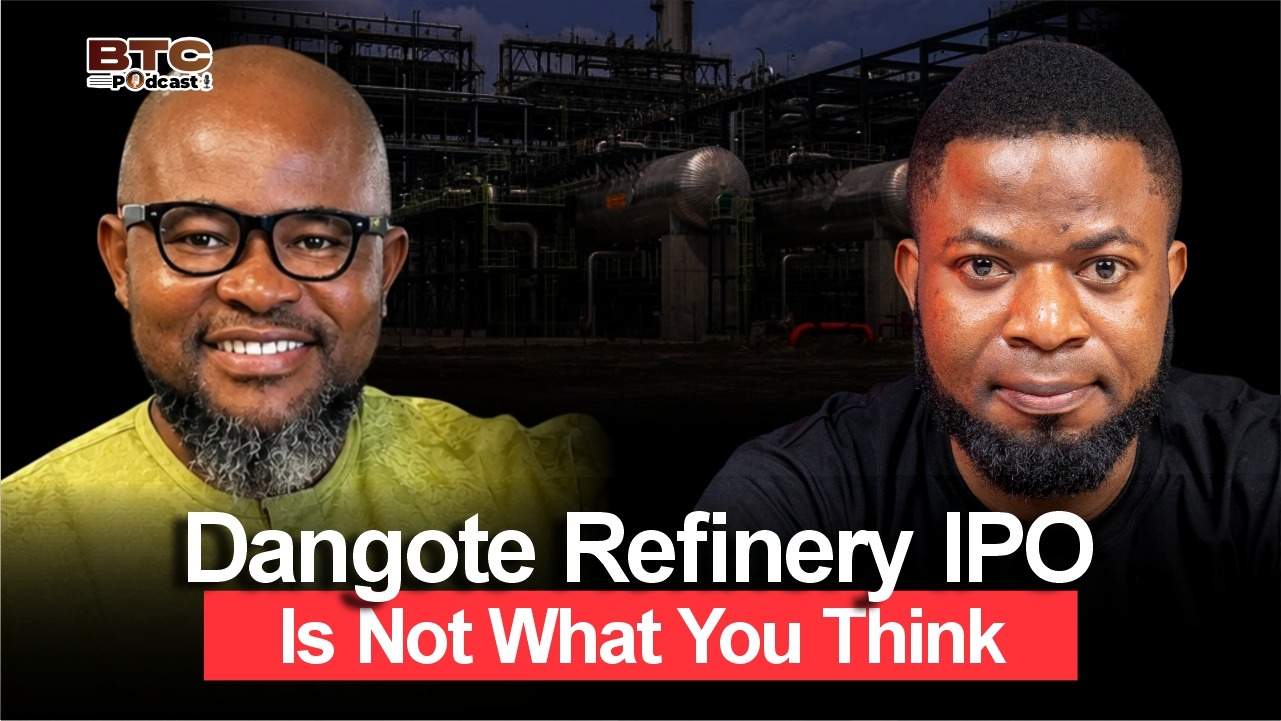
The Dangote Refinery shares IPO has generated enormous interest across Nigeria, with banks, financial influencers and social media personalities drawing attention to the opportunity.
But should investors rush to buy Dangote Refinery shares simply because everyone seems to be talking about them?
That was one of the central questions discussed on the latest episode of the Before Tomorrow Comes Podcast (BTC Podcast), hosted by Prince Gabriel Okocha (PGO).
In the episode, PGO spoke with Barrister Azubuike Ihemeje, a lawyer, financial expert and entrepreneur, about the Dangote Refinery IPO, the excitement surrounding the offer, the company’s debt, potential dividends, oil prices, profitability and the risks investors should consider before committing their money.
The conversation offered a different perspective from the promotional messages surrounding the Dangote Refinery shares.
Rather than simply asking whether the shares are good or bad, the discussion focused on a more important question:
Do investors fully understand what they are buying before they subscribe?
What Is the Dangote Refinery IPO?
The Dangote Petroleum Refinery and Petrochemicals public offer gives eligible investors an opportunity to apply for shares in the company.
The official IPO information states that the offer involves 4.1 billion ordinary shares at ₦525 per share, with a minimum subscription of 10 shares, equivalent to ₦5,250.
The offer opened on September 14, 2026, and is scheduled to close on October 13, 2026.
However, the existence of an IPO does not automatically mean that every investor should participate.
Buying shares means becoming an investor in the company, which also means accepting the risks associated with the company’s future performance.
That distinction was central to the conversation between PGO and Barrister Azubuike Ihemeje.
Why Is Everyone Talking About Dangote Refinery Shares?
According to Barrister Azubuike Ihemeje, the level of publicity surrounding the Dangote Refinery IPO is one of the reasons so many Nigerians have become interested.
During the podcast, he described the publicity as extensive, pointing to the involvement of banks, financial influencers and other platforms promoting the opportunity.
The concern he raised was not simply that the IPO was being promoted.
His concern was that some people may be subscribing because “everyone is doing it” rather than because they have studied the company’s financial position and the prospectus.
That distinction is important for any investor.
A popular investment is not automatically a suitable investment for every person.
Should You Buy Dangote Refinery Shares?
The podcast did not present a simple yes-or-no answer.
In fact, Barrister Azubuike Ihemeje specifically stated that he would not tell people not to buy the shares.
Instead, he said investors should examine the information available in the prospectus and consider the economics of the oil and gas business before making their decision.
This is perhaps one of the most important lessons from the conversation.
The question should not only be “How much can I make?” but also “What could go wrong?”
Investors considering Dangote Refinery shares should therefore pay attention to the company’s financial position, profitability, debt obligations, business outlook, dividend policy and the factors that could affect its future earnings.
Dangote Refinery Debt: Why It Matters to Investors
One of the strongest points raised during the conversation was the issue of indebtedness.
Barrister Azubuike Ihemeje argued that investors should not look only at the refinery’s scale or profitability. They should also examine its obligations and how those obligations could affect the company’s ability to distribute profits.
During the podcast, he referred to figures he said were contained in the prospectus and discussed a debt burden running into trillions of naira.
These figures were part of the guest’s discussion and interpretation of the prospectus and should be checked against the latest approved prospectus before being relied upon for an investment decision.
The broader point, however, is straightforward:
A company’s revenue or profit does not tell the entire investment story.
Investors also need to understand its liabilities, financing structure, capital requirements and future spending.
A company can be profitable while still having significant financial obligations.
What About Dangote Refinery Dividends?
Another major issue discussed on the podcast was dividends.
Many people buying shares are naturally interested in one question:
When will I start receiving dividends?
But dividends are not the same thing as guaranteed interest.
When you buy shares, you become a shareholder. Your potential returns can come from dividends declared by the company and, depending on the investment and market conditions, changes in the value of the shares.
The official Dangote IPO information also makes clear that dividends are not guaranteed. Whether dividends are declared depends on factors including the company’s performance, cash requirements and decisions of its Board.
That makes the guest’s recommendation to study the prospectus particularly relevant.
Anyone expecting quick dividend income should understand how the company’s financial obligations and capital requirements could affect distributions.
Why the Oil Price Matters
Dangote Refinery operates in the petroleum and energy sector, meaning its economics can be affected by changes in the global oil market.
During the BTC Podcast discussion, Barrister Azubuike Ihemeje raised the possibility that circumstances affecting oil prices could change.
His argument was essentially that an investment thesis based on current market conditions must account for the possibility that those conditions could change.
For example, if assumptions about oil prices, geopolitical conditions, supply or demand change, the company’s future profitability could also be affected.
This is an important investment principle beyond Dangote Refinery:
Past or current profitability does not guarantee future profitability.
Investors have to consider what could happen if the conditions supporting the current business outlook change.
Is Dangote Refinery a Ponzi Scheme?
The podcast also addressed one of the most controversial claims circulating around the Dangote Refinery IPO.
Barrister Azubuike Ihemeje explicitly distinguished the refinery from a Ponzi scheme.
His reasoning was that the refinery is an operating business with physical assets, products and commercial activities, rather than a scheme that simply promises investors returns without a genuine underlying business.
However, he also said that some of the publicity and expectations surrounding the investment could give people what he described as “Ponzi vibes.”
That distinction is important.
Calling an investment a Ponzi scheme is a serious allegation. Investors should distinguish between criticism of promotional messaging, concerns about expected returns and evidence of an actual fraudulent scheme.
The discussion on the podcast was therefore more about investment hype and expectations than a conclusion that Dangote Refinery itself is a Ponzi scheme.
The Importance of Reading the Dangote Refinery Prospectus
Perhaps the most repeated message from the conversation was simple:
Read the prospectus.
A prospectus contains important information about an investment offer, including information about the company, the offer, financial information, risks and other matters investors need to understand.
The Securities and Exchange Commission has also advised prospective investors to carefully read the approved prospectus and understand the terms, conditions and risks associated with the Dangote Refinery IPO before subscribing.
This is particularly important when an investment opportunity is receiving significant publicity.
Instead of relying entirely on:
- WhatsApp messages
- Social media influencers
- Bank advertisements
- Friends and family
- Viral videos
- Claims about how much money you could make
investors should go directly to the official documents and understand the investment for themselves.
Is Dangote Refinery a Risk-Free Investment?
No investment in shares should be treated as risk-free.
The official Dangote IPO website itself warns that the value of an investment can rise or fall and that investors may not get back the amount they invest.
This was also one of Barrister Azubuike Ihemeje’s major points during the BTC Podcast conversation.
He described shares as risky and emphasized the importance of understanding volatility.
The fact that Dangote Refinery is a major industrial asset does not eliminate investment risk.
Its future performance can still be affected by factors such as:
- Oil prices
- Refining margins
- Currency movements
- Interest rates
- Debt obligations
- Operating costs
- Government policies
- Competition
- Global energy markets
- Geopolitical developments
- Capital expenditure
- Demand for petroleum products
Understanding these risks is more useful than simply focusing on the popularity of the company.
Why Barrister Azubuike Ihemeje Says He Would Not Personally Subscribe
One of the most interesting moments of the interview came when PGO asked Barrister Azubuike Ihemeje whether he personally intended to invest in the Dangote Refinery shares.
His response was nuanced.
He said he would not tell people not to buy the shares, but explained that he personally would not subscribe.
He then explained his broader approach to investments.
According to him, he tends to avoid the personal liabilities associated with directly purchasing shares and instead considers investment arrangements involving financial institutions and agreed returns.
He described using fixed-deposit arrangements as part of his personal investment approach.
This does not mean that fixed deposits are automatically better than shares, nor does it mean that his personal strategy is suitable for every investor.
Rather, it demonstrates an important principle:
Different investors have different risk tolerances, objectives, time horizons and investment strategies.
What works for one investor may not work for another.
What Should Young Nigerians Consider Before Buying Dangote Shares?
For young Nigerians who are considering the IPO, the conversation raises several questions worth answering before investing.
1. Can you afford to lose the money?
Money needed for rent, school fees, food, emergencies or essential expenses should not automatically be committed to a volatile investment.
2. What is your investment timeframe?
Are you looking for short-term gains, dividend income or long-term ownership?
Your answer can significantly affect how you evaluate the investment.
3. Have you read the prospectus?
If you have not read the prospectus, you may be making your decision based primarily on someone else’s interpretation.
4. Do you understand the risks?
Every investment comes with risks. Understanding them is part of making an informed decision.
5. Are you investing because you understand the opportunity—or because everyone else is doing it?
This was one of the central concerns raised during the BTC Podcast discussion.
The Biggest Lesson From the Dangote Refinery IPO Debate
The biggest lesson from the conversation between PGO and Barrister Azubuike Ihemeje is not necessarily that people should buy or avoid Dangote Refinery shares.
It is that investors should slow down long enough to understand what they are buying.
The excitement surrounding a major Nigerian industrial project can be enormous.
But excitement is not the same thing as financial analysis.
The prospectus matters.
The company’s financial position matters.
Debt matters.
Profitability matters.
Dividends matter.
Oil prices matter.
Risk matters.
And, perhaps most importantly, the investor’s own financial situation matters.
Watch the Full Before Tomorrow Comes Podcast Episode
In the latest episode of Before Tomorrow Comes Podcast (BTC Podcast), Prince Gabriel Okocha (PGO) and Barrister Azubuike Ihemeje go deeper into the Dangote Refinery IPO and the questions potential investors should be asking.
The conversation covers the IPO hype, the prospectus, debt, dividends, oil prices, geopolitical risks, Dangote’s market position and the personal investment strategy of Barrister Azubuike Ihemeje.
If you are currently considering buying Dangote Refinery shares, the discussion provides several issues worth considering before making your own investment decision.
Watch the full episode and hear the conversation for yourself.
Frequently Asked Questions About Dangote Refinery Shares
What is the Dangote Refinery IPO?
The Dangote Refinery IPO is a public offer through which eligible investors can apply for shares in Dangote Petroleum Refinery and Petrochemicals FZE.
How much is one Dangote Refinery share?
The official IPO information currently lists the offer price at ₦525 per share.
What is the minimum Dangote Refinery IPO subscription?
The official IPO website lists a minimum subscription of 10 shares, equivalent to ₦5,250.
Are Dangote Refinery dividends guaranteed?
No. Dividends are not guaranteed. Whether dividends are declared depends on factors including company performance, cash requirements and the Board’s decision.
Is buying Dangote Refinery shares risk-free?
No. Shares carry investment risk. Their value can rise or fall, and investors may lose some or all of the money invested.
Is Dangote Refinery a Ponzi scheme?
Barrister Azubuike Ihemeje said during the BTC Podcast interview that he does not consider the refinery a Ponzi scheme, while expressing concern about some of the hype and promises surrounding the investment.
Should everyone buy Dangote Refinery shares?
There is no single answer that applies to every investor. Potential investors should consider the approved prospectus, risks, financial position, investment objectives, time horizon and ability to withstand losses before making their own decision.
Final Thoughts
The Dangote Refinery IPO has become one of the most closely discussed investment opportunities in Nigeria, but the excitement surrounding an investment should never replace proper research.
As Barrister Azubuike Ihemeje emphasized during his conversation with PGO, investors need to look beyond the publicity and examine the underlying information.
The right question is not simply:
“How much money can I make?”
It is also:
“What am I actually investing in, what could affect its performance, and can I afford the risks?”
Those are the questions investors should answer before putting their money into Dangote Refinery shares.
About the Podcast
Before Tomorrow Comes Podcast (BTC Podcast) is hosted by Prince Gabriel Okocha (PGO) and features conversations about business, money, politics, entertainment, religion, family, trends and important issues affecting everyday life.
Guest: Barrister Azubuike Ihemeje
Host: Prince Gabriel Okocha (PGO)
Podcast: Before Tomorrow Comes Podcast (BTC Podcast)
Disclaimer: This article summarizes and discusses views expressed during a podcast conversation. It is not financial, investment or legal advice. Investment decisions should be based on independent research and the official offer documents, and readers should consider consulting appropriately qualified financial professionals where necessary.